The alignment triangle: how to avoid misalignment
“We are not aligned”
How do you approach misalignment? What can you do to proactively avoid it?
In a professional context misalignment happens in different situations and at various levels. I have clients who either discover that they have aligned poorly when delegating, or repeatedly find themselves misaligned with peers from other departments.
And if you are a product leader I am sure you have been in countless alignment meetings that expose misalignment on topics like priorities, deadlines or release readiness.
Misalignment happens in the context of agreements. And in my experience the reason for most misalignments is a difference in personal preferences how to prioritise time, scope and quality.
My take on misalignment is that it is a 2-step process. When making an agreement:
Each of us, individually, care most about either time, scope or quality. Some people are aware of making this choice and can explain it, while for others it is an emotion, often subtle, that they cannot explain or be consciously aware of.
As long as the agreement is kept, this difference in prioritisation preference does not create a problem. But when something unexpected happens and the agreement has to change, each party considers “their” priority non-negotiable, and can only imagine discussing the other two. Unless these preferences match, there is misalignment.
An example to illustrate this: Anne and John have made an agreement. John will create a slide deck for Anne by the end of March, for her to use in the mid-April quarterly business review.
Anne has a lot to do, and is aware of really wanting this slide deck to be done by the end of March, so she has enough time to review it and practice her presentation of it.
John on the other hand, considers himself a perfectionist, and feels uncomfortable with the idea to deliver something that is half-baked. He will make this slide deck the best one they have ever created.
In their alignment meeting one week before the end of March, it becomes clear that John will not be able to stick to their agreement.
John starts a conversation about how he cannot see a possibility to scope the work differently, so he proposes to push the deadline with 1,5 weeks. “It is the only possibility” he says. He does not even consider reducing the quality, so he says nothing about it.
Anne however, when hearing John’s proposal, imagines her tight schedule exploding if this work slips, and feels her stress level increase. “Postponing? No! Obviously we need to look at other options. Reducing the scope is hard, I agree. But perhaps we don’t need to spend so much time on perfecting the animations and slide transitions?"
John starts feeling unwell. He is cold-sweating and feels light-headed. “No! We will look unprofessional!”.
It has become clear that Anne and John are misaligned.
The alignment triangle
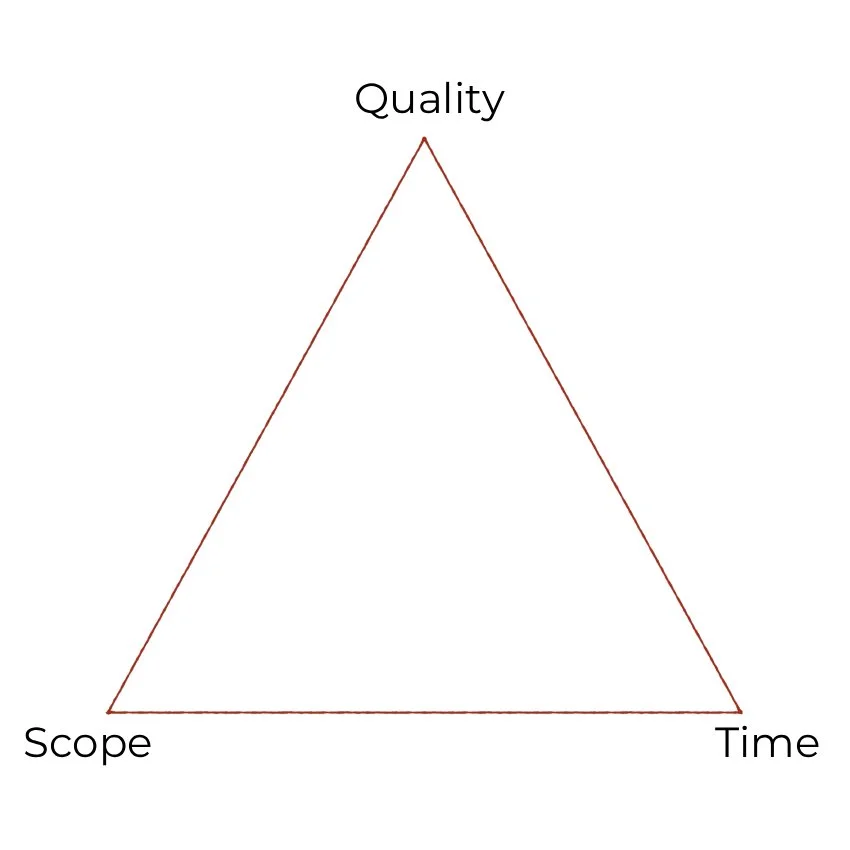
You can interpret the triangle as a rope with the two ends tied together. Pulling the rope in one corner will impact one or both of the other two corners.
Your job is to use both your hands to hold two corners in place, and decide which corner to ignore (you only have two hands!). This illustrates how it is impossible to care about all these 3 alignment aspects equally.
In an agreement context that translates into:
Only one can be fixed in place = the indisputable aspect
The second one will be used to measure progress and readiness
Accept that the third one will remain unpredictable
My approach to resolving misalignment, or avoiding it altogether, is to use the alignment triangle and agree what to let go of. Because you can’t have it all.
For example: if you care most about the scope, you can lock it down - if you actively use quality or time to measure readiness. In other words: you need to accept that either the release date or the quality level will remain unpredictable.
Another example: lock down the quality level, and decide whether to leave either scope or release date unpredictable.
Misalignment in product or project delivery
So far we have covered how to reveal misalignment in an agreement between two people. But what about misalignments in the context of a product release or project?
The root cause is the same: a difference in personal preferences that, when exposed, makes it harder to reach a shared understanding and find a way forward.
With more people being involved and stakes being higher, the conversations get more complex and it becomes harder to interpret each stakeholder’s personal preference and where the differences are.
But keeping mind that we are focusing on personal preferences, the clues are to be found in how different opinions and concerns are expressed. The language used.
In my experience they tend to be variations of three kinds of statements:
“We’re not ready” or
“We can’t delay” or
“I need feature X”
With the alignment triangle as reference, we can see that
“We’re not ready” = a personal preference to care most about quality
“We can’t delay” = a personal preference to care most about time
“I need feature X” = a personal preference to care most about scope
Having concluded the others’ personal preferences, the question to ask yourself before attempting to re-align is: what is your own preference?
Next time:
This was the first article on the alignment triangle. Next time I will cover how several development methodologies, processes and frameworks have been designed with these alignment challenges in mind.